
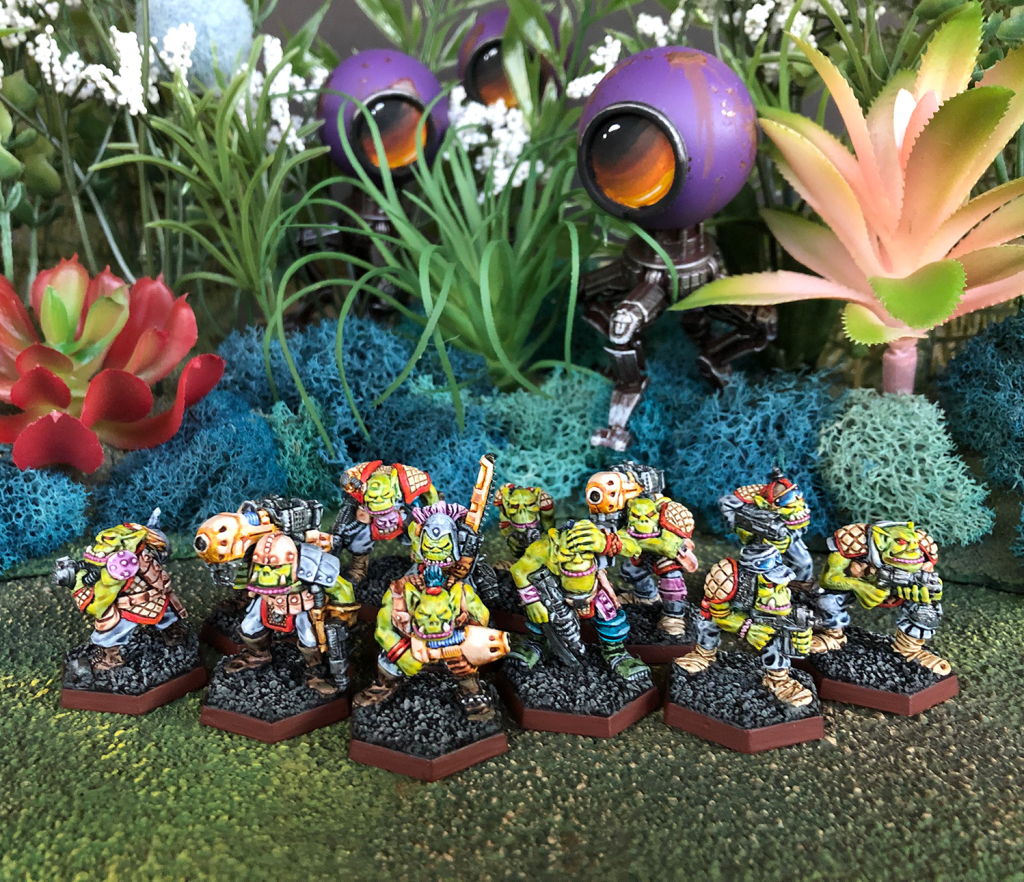
What’s the point of being a warboss if you don’t have any mobs to boss around? And if you’re going to venture into “Genetic Park,” you’re going to need all the help you can get.

When coming up with the army list for the challenge, I based my selections upon the figures I wanted to paint rather than any sense of game strategy. I wanted to keep these mobs small so that I could paint twice as many special/heavy weapons, rather than have a big mob of 12 models that could only have 2 special/heavy weapons. I’ve always loved plasma guns, so I made sure to fill the mobs with as many plasma-toting models as I had available. One of the boys seemed to be wearing a cutoff leather jacket, which gave me the feeling that he must be a fan of the ‘Main Man,’ so I added my nod to Bisley’s 1992 cover for “Lobo’s Back” issue #1.

The real work this month was spent getting ready for DrTheViking’s campaign: “Return to Hamelia XI.” I haven’t played a game of 40k in many years, and I don’t have a wargame table. All of that stuff was at my friends house, and he moved a long time ago. After reading the campaign PDF, I was inspired to build a whole setup! Since I now have a fair amount of Orks complete, and because I want to teach my daughter how to play 40k, I figured there’s no better time than now to finally get a proper wargame table.
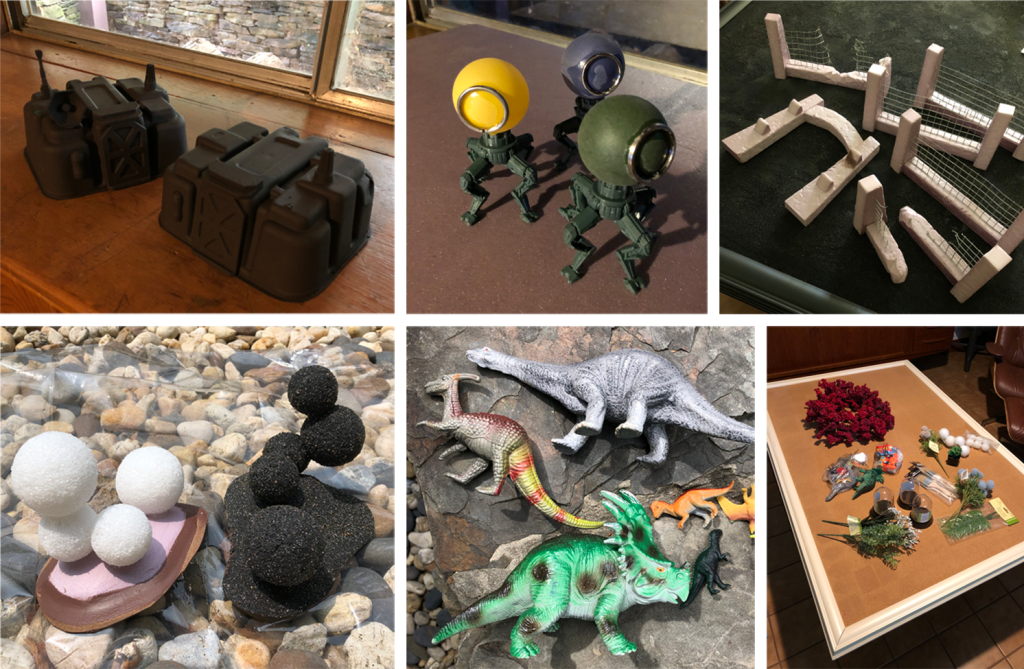
The campaign setting of a Genetic Park is perfect for getting a variety of terrain features into play. Honestly, as I was reading the PDF I knew exactly what I wanted to design for each campaign scenario. I tried to build enough items to cover a variety of the special conditions, and still be able to store it all. I picked up a bag of plastic dinos at the thrift store that had the right look for a sauropods stampede, and I painted them up right away so that I could use them for inspiration as I worked.
The table itself is a large, framed, cork bulletin board from the thrift store ($5 USD). It saved me so much time and money finding that bulletin board. I wanted to make sure that all the terrain I made would match the table, so I worked on all of the landscape at the same time so that I could ensure the paint color and style would blend from the table itself to the terrain upon it. In the past I used static grass and flock to cover my gameboard and terrain. It looks amazing, but I find that they shed from pushing miniatures across the table, and I get annoyed by static grass clinging to all my electronics. So for this table and terrain, everything is covered with different types of sand, from fine to coarse, sprinkled randomly to give it variety. Basically the same as you’d do for a miniature’s base. Then I base coat it to seal all the sand in place by using green house paint mixed with wood glue, 3 parts paint to 1 part wood glue. Dries solid as a rock. It’s the same method I used for my army display base in the challenge.


I wanted the foliage to look suitably alien, and those weird puffballs jumped out at me as being the perfect fit for the majority of the jungle stands. “West Indigen Lilac” was made using a weird floral piece composed of tiny red balls. I’m not sure what it was supposed to be, but I found it in the fake flowers section of the thrift store. The “maintenance sheds”/Kawah Bunkers are made from mushroom cartons, wire nuts, a flying hex base, and a Hirst Arts plaster cast door. The “tourist transport wrecks” were inspired by the little gyrosphere vehicles from Jurassic World, and were made using ping-pong balls, key rings, and legs from dollar store toys. The “large electrical fences” are styrofoam and metal screen, and I tried to give them the same feel as the “Jurassic Park” gateway from the first movie. The “alien cacti” is of course everyone’s favorite spikey boy from White Dwarf. I never had any of these back in the day, so I had to make some. They are damn dangerous to handle. I used really cheap styrofoam balls from the dollar store (a pack of 6 for a dollar) but they were made from a brittle styrofoam, so I coated all the cacti with the same sand/glue method that I used for the table/hills/bases. The structures and vehicles were tied together using the Genetic Park color palette to add that menacing purple and yellow. I printed up a bunch of little signs that I added to buildings, fences and vehicles to give them all a lived-in look. The weathering was done using salt-chipping, like I used on my Ork vehicles.
Everything in that table picture was created this month for the campaign (and I managed to play a quick mission of Orks versus Tyranids! Read more at the Cowabunga Journal). It’s way more than you’d ever use in a single game, but I figured I’d get as much done from the special rules and terrain suggestions all at once, so I wouldn’t have to fill up the basement again later to make more pieces. I still have 4 more terrain items that are almost finished (2 more hills, a greenhouse, and an heretical shrine), but I’ll need to complete them next month. I’m exhausted, but all the effort was worth it!
 Giant Pygmy